

Words: Skin & Ink Editorial Staff
A tattoo looks still. Its surroundings are anything but. Skin is living tissue, and the image remains in a biological setting rather than being locked beneath a sheet of glass. That makes tattoo permanence an interesting scientific question: how can a recognizable mark survive while the cells around it change?
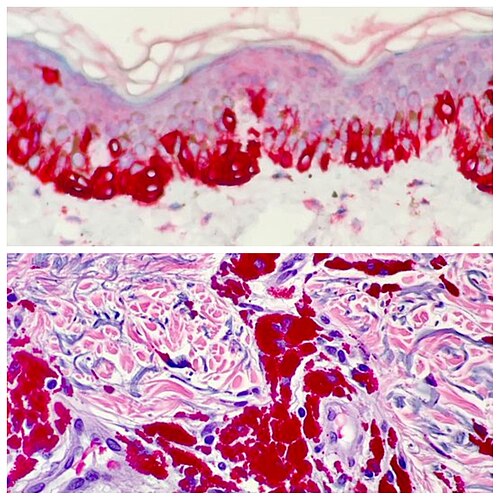
One influential answer comes from work on macrophages, immune cells that can take up foreign material. In a 2018 experimental study, researchers followed tattoo pigment in mouse skin. Their results supported a cycle in which pigment released from dying macrophages could be captured by other macrophages. The image did not depend simply on the original pigment-containing cells surviving indefinitely.
An explanation has boundaries
The study is often reduced to a memorable story about the immune system keeping a tattoo in place. The qualification belongs beside the story: the experiment used mice, and the authors said the model’s applicability to humans remained to be determined. That limitation does not erase the finding. It tells the reader what kind of finding it is.
A responsible account also separates permanence from safety. Showing one way pigment can remain in tissue does not establish that every ink formulation is harmless. Equally, identifying an immune response does not by itself establish that every tattoo creates a clinical illness. Those are different research questions requiring different evidence.
Ask what a claim actually measures
When a headline connects tattoos with the immune system, look beyond the headline before changing your plans. Was the work conducted in cells, animals, or people? What outcome was measured? Did the researchers study a particular pigment, exposure, or group? Does the conclusion match the experiment, or has someone stretched it into a universal rule?
These questions are especially valuable when a scientific finding gets attached to a product pitch. A bottle label or an aftercare advertisement may borrow medical vocabulary without demonstrating the claim a client assumes it makes. Ask for the actual evidence and its relevance to the exact product and intended use. Technical language should make an explanation more precise, not harder to question.
Bring the science back to the appointment
A client does not need to master immunology to make a thoughtful decision. They do need an artist who identifies products, maintains appropriate records, explains aftercare, and refers medical concerns to qualified professionals. Scientific uncertainty is a reason for transparency, not a reason to replace everyday safeguards with confidence.
For an existing tattoo, keep aesthetic concerns separate from symptoms. A line you wish were darker calls for a design conversation. A persistent or unexpected skin reaction calls for medical evaluation. Trying to solve both with the same advice invites mistakes.
The deeper fascination is that a tattoo’s permanence is active rather than inert. Research continues to examine the systems surrounding the mark. We can appreciate that complexity without turning one study into a cure-all, a scare story, or a guarantee. The image may be familiar; the science still deserves careful reading.
Sources
Baranska and colleagues, Journal of Experimental Medicine (2018)