
Words: Skin & Ink Editorial Staff
A memorial tattoo does not have to resemble a memorial. It can be a familiar kitchen utensil, an ordinary flower, a piece of handwriting, or an image that makes the wearer laugh. The person looking at it may recognize an entire relationship that a stranger sees only as decoration.
That privacy is part of its value. Remembering someone does not require a public explanation, and a tattoo does not have to demonstrate the depth of a loss to anyone else. The design can carry as much or as little of the story as the wearer wants.
Begin with the person, not the convention
Before choosing a symbol, consider what feels specific. A date records when something happened. A favorite object can suggest how a person lived. A portrait asks the artist to work with likeness; handwriting asks them to interpret a particular mark. These are different design tasks, and the strongest choice is the one that fits the memory the client wants to keep close.
A collection of references can help, but there is no obligation to include everything. One well-chosen element may leave more room for recognition than a crowded inventory of names, dates, places, and symbols. Talk through what is essential and what can stay in the story without appearing in the tattoo.
Give exact details an extra check
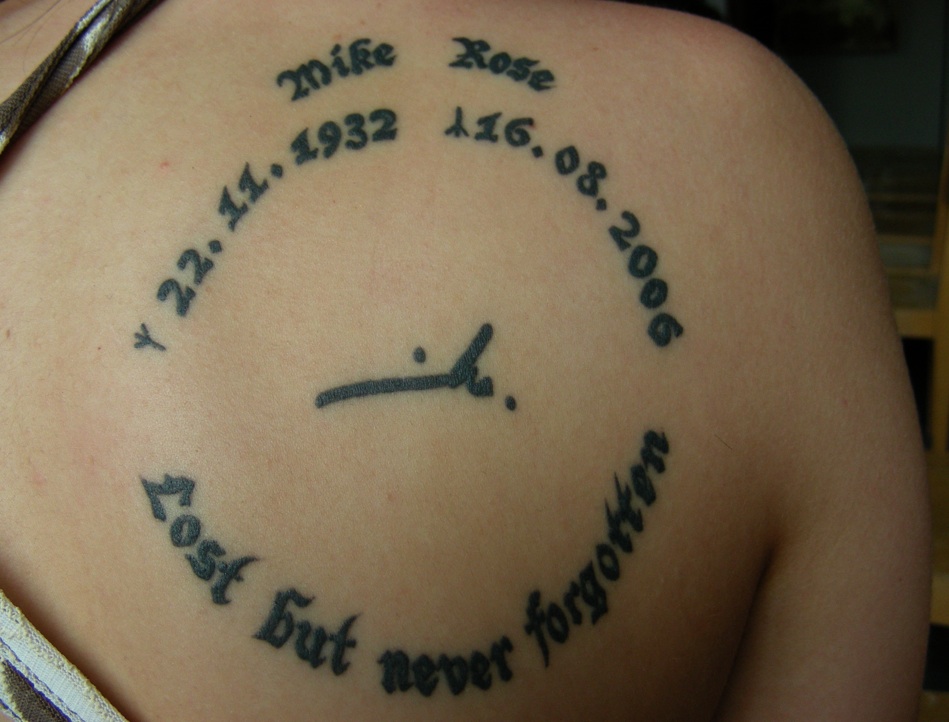
Names and dates deserve a calm verification process. Read them independently, check the source, and look again at the final design. If handwriting comes from a note or card, preserve the original and discuss which marks should remain as written. An unusual letter may be precisely what makes the image familiar.
For a portrait, ask about the quality of the reference and the artist’s experience with comparable work. A treasured photograph can be emotionally important while providing limited visual information. Discuss that limitation before assuming the artist can recover details the image does not contain.
Let the timetable belong to the wearer
An anniversary can be a meaningful date for an appointment, but it should not become a deadline that forces uncertainty into a permanent decision. Someone may know immediately what they want. Someone else may need years. Neither timetable measures the importance of the relationship.
The artist can offer room to pause without diagnosing grief or prescribing a waiting period. A tattoo may be comforting to a particular person, but it should not be sold as a treatment or a necessary step toward healing. Choosing not to get one is equally valid.
Make the publication decision separately
A photograph of a memorial tattoo can expose a name, date, or private connection. Ask what the client is comfortable sharing, including whether the meaning should be described at all. The answer may be different from their willingness to display the artwork in daily life.
A memorial also remains open to change in interpretation. The same image may bring sadness on one day and affectionate amusement on another. That does not make it inconsistent or unsuccessful. It belongs to a living person whose relationship with memory continues.
The best design consultation makes room for those possibilities without trying to settle them. A memorial tattoo can be solemn, playful, highly visible, or quietly tucked away. Its most important audience is the person who will encounter it every day, carrying a connection in a form they chose for themselves.