Words: Skin & Ink Editorial Staff
A large Japanese-style tattoo asks the viewer to look beyond a single subject. A dragon may draw the eye first, but the composition also depends on the shapes surrounding it, the space it leaves, and the way the design continues around the body. The background is doing work even when it receives less attention than the creature inside it.
The Museum of Fine Arts, Boston's Tattoos in Japanese Prints exhibition connects pictorial tattoo imagery with Edo-period woodblock prints, including work by Utagawa Kuniyoshi. That relationship offers useful visual context. It does not turn a print into a complete instruction sheet for tattooing or make every contemporary composition answer to one simple formula.
Begin with the silhouette
A bodysuit is encountered in motion and from more than one angle. Before studying individual scales or petals, look at the large shapes. Where does the eye enter? Which areas feel dense, and which provide relief? Does a strong movement on the back continue coherently around the side, or does it end abruptly when the wearer turns?
These are design questions, not a ranking of cultural legitimacy. Different artists can make different choices while working with related visual material. The useful discussion is specific to the composition in front of you and the practitioner who made it.
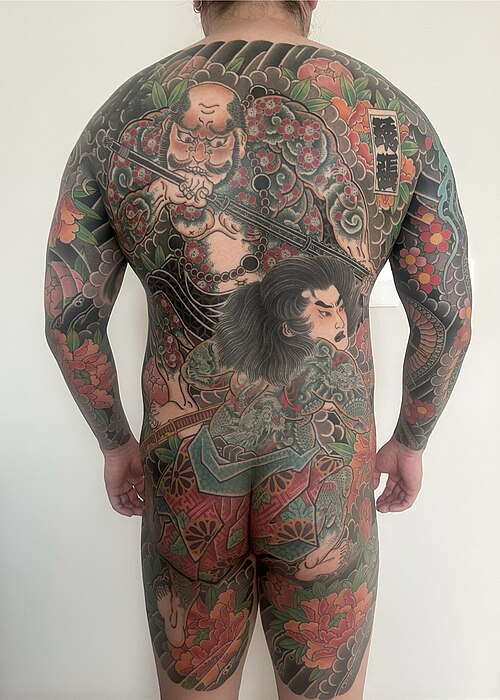
For a collector considering a large project, ask to see more than one tightly cropped portfolio image. Wider views help reveal how the tattoo relates to shoulders, waist, limbs, and existing work. Healed photographs offer a different kind of information from fresh close-ups. Neither view alone describes the entire project.
Plan relationships, not just motifs
A list of favorite subjects is a starting point for conversation, not necessarily a coherent bodysuit. Discuss which image should lead, which elements support it, and what can be left out. Adding another meaningful object may weaken the whole if it competes for the same visual role.
The artist should be able to explain the proposed relationships in plain language. Where will the largest masses sit? How will transitions work? Which areas are planned now, and which remain open? A client does not need to learn every specialist term to understand the broad decisions being made about their body.
Historical or symbolic claims need the same care. Avoid relying on an internet chart that assigns a fixed meaning to every flower, animal, or color. Ask the practitioner about their references and approach. If a specific story matters to the client, verify it rather than assuming that a familiar-looking motif carries one universal message.
Think beyond the first session
A large project also needs practical planning: expected stages, costs, breaks between appointments, and how changes will be discussed. A collector should understand what the composition may look like while unfinished and how existing tattoos affect the plan.
The reward of a successful bodysuit is not simply maximum coverage. It is the relationship between image and wearer, visible whether someone studies a detail or sees the body move across a room. Appreciating that relationship means giving composition as much attention as iconography, and giving the artist's actual work more weight than a rule repeated without context.
Sources