Words: Skin & Ink Editorial Staff
A military tattoo can be an emblem of service, a private memorial, a joke between friends, or a piece chosen for reasons that have little to do with the uniform. The person wearing it is the only reliable starting point. An anchor does not tell a complete biography, and a date does not authorize a stranger to ask for the worst day behind it.
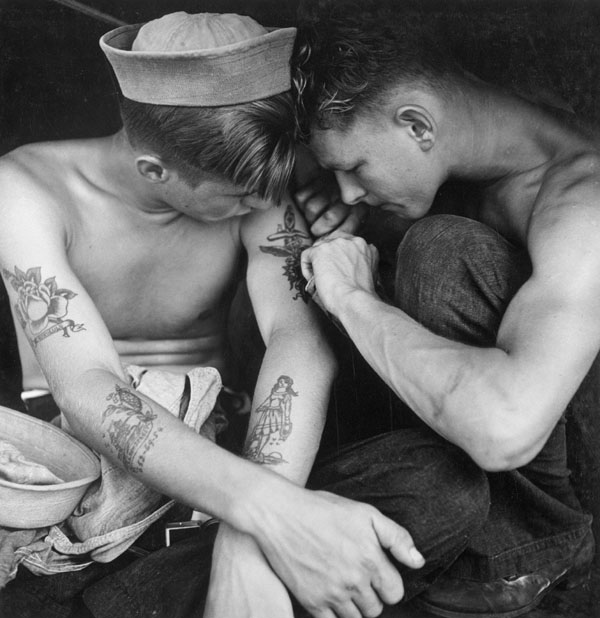
The National Museum of the American Sailor has documented tattooing through exhibitions including A Culture of Ink and Marked by the Sea. That institutional record gives the subject historical context. It should not encourage us to treat every veteran's collection as an example of the same story. Service, wartime experience, and personal identity overlap differently for different people.
Ask what should be carried forward
For an artist designing a service-related piece, accuracy matters before symbolism. Confirm names, dates, unit identifiers, insignia, and spelling with the client. Do not rely on a low-resolution image or assume that similar-looking emblems are interchangeable. Give the wearer a clear opportunity to review the final design and stencil.
A memorial can become crowded when every meaningful detail is given equal visual weight. Ask which element needs to be immediately recognizable and which can remain private or be left out. A restrained composition may be easier to live with than one assembled from every available photograph, motto, and date. The measure is the client's intention, not how much information fits in the drawing.
The conversation does not require a detailed account of someone's service. A client can specify the image and decline to explain its emotional history. That boundary should be easy to maintain, even in a friendly shop where conversation normally flows throughout a session.
Do not promise a cure
Tattooing may be an important experience for a particular person. It is still inappropriate to market an appointment as a treatment for trauma or assume that enduring pain produces emotional recovery. An artist can offer attentive work, breaks, clear consent, and respectful company without making a clinical promise.
If an appointment becomes difficult, the client should be free to pause or stop. Discuss those options before starting rather than treating endurance as evidence of strength. The goal is a well-considered tattoo completed safely, not another test a person must pass.
Share only what was offered
Portfolio captions need separate approval. A client may welcome a photograph of the finished work while declining to name someone memorialized or describe a particular event. Avoid adding dramatic language that turns an ordinary design description into a public account of grief.
The same restraint applies to an existing tattoo. Do not infer combat experience, loss, or political beliefs from its appearance. A veteran's body does not become public property because it carries a recognizable emblem. Good tattooing gives someone control over the mark they choose. Good storytelling should preserve that control when the work leaves the studio and enters a magazine.
Sources