Words: Skin & Ink Editorial Staff
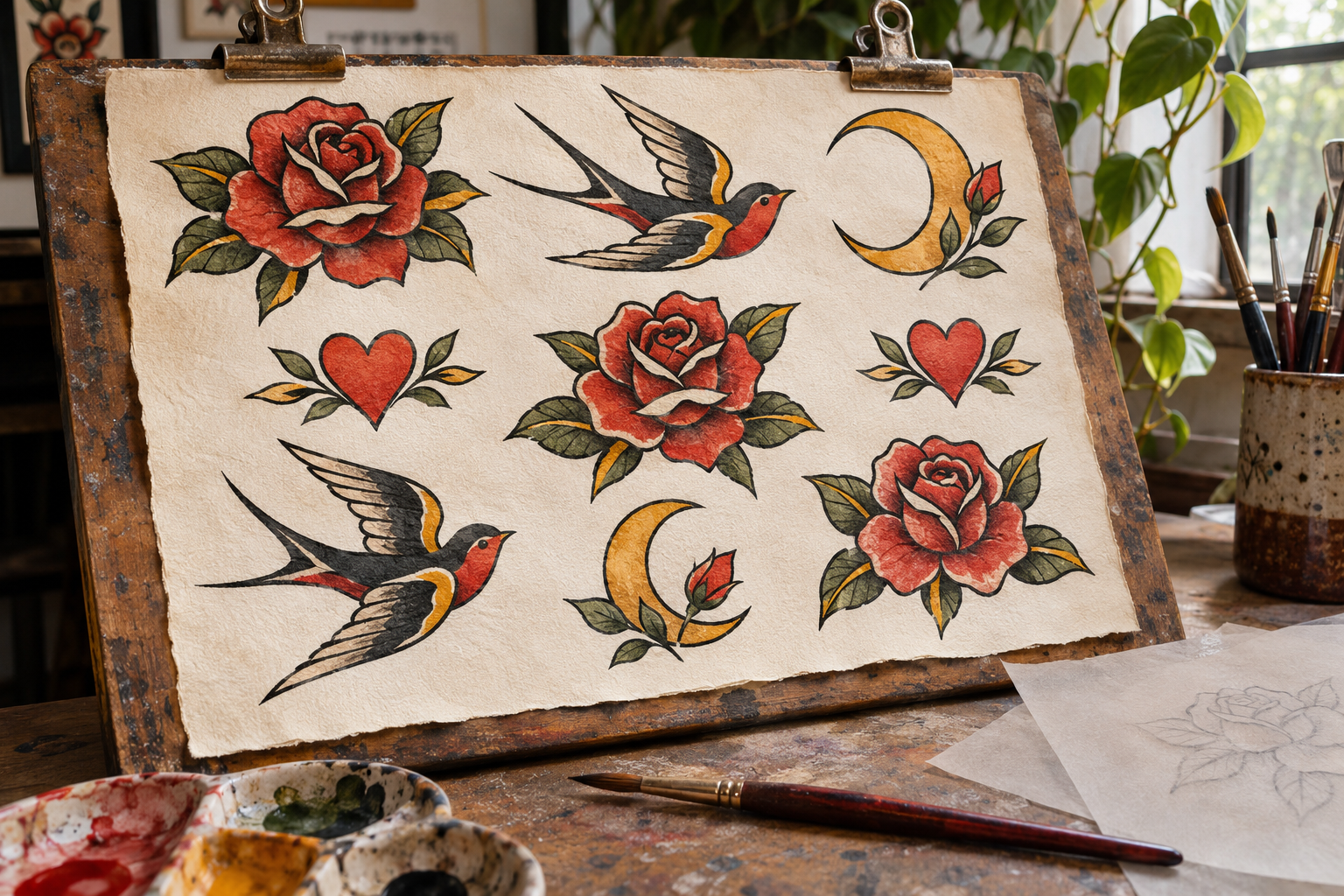
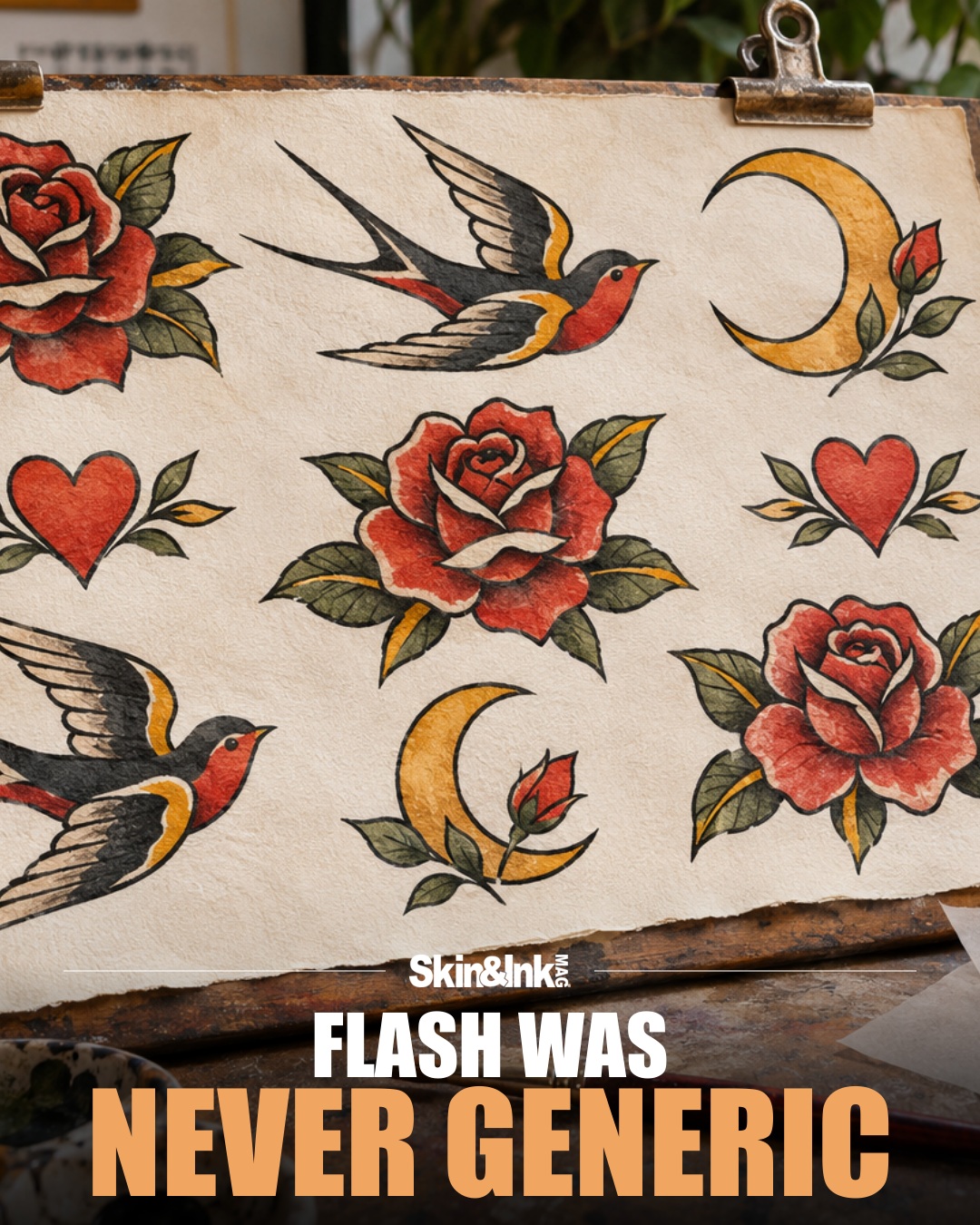
A flash sheet does several jobs at once. It offers choices, presents an artist’s drawing, and places images in conversation with one another. A rose beside a dagger is a different invitation from the same rose isolated in a portfolio. The sheet tells a client something about the world of the studio before anyone begins discussing placement.
Calling that work generic because it may be repeated overlooks the decisions that made it readable and appealing. Repetition can flatten an image when it becomes careless copying. It can also reveal how a compact design changes through different hands, scales, and arrangements.
Look closely at the object
Historical flash survives as physical evidence. The Henry Ford’s collection includes a sheet dated circa 1925 associated with Percy Waters. The St. Louis Mercantile Library holds binders of flash and reference material compiled from around 2002. Those objects give researchers something more specific to examine than a claim that all traditional imagery came from one source.
A sheet can be studied for line, spacing, color, lettering, and arrangement. Its annotations or accompanying business cards may help establish where it was used. The maker’s name and the object’s provenance matter because a design can travel far from the context in which someone first drew or sold it.
The same attention can improve a contemporary consultation. Ask what drew you to a particular image. Is it the silhouette, the expression, the amount of black, or the relationship between two elements? Those observations can guide scale and placement without assuming that the only valuable tattoo is one invented from nothing.
Repetition needs clear terms
Artists use the word flash in different ways. A sheet may contain designs intended for repeated tattooing, a set of one-off offers, or examples that will be adapted for each client. Before booking, ask which arrangement applies. A collector deserves to know whether the image may appear on another person, and an artist deserves to have their stated terms respected.
An old image circulating online creates another kind of uncertainty. Its age alone does not provide a complete rights history. Identifying the source and asking appropriate permission is better practice than treating a familiar motif as automatic authorization to reproduce a specific drawing.
A shared language leaves room for a voice
Traditional subject matter gives artists a vocabulary, but vocabulary does not dictate every sentence. A bird’s angle, the weight of a border, or the space around a face can change the character of a familiar image. Skilled variation is visible when the viewer slows down enough to notice those choices.
For collectors, choosing from a sheet can be a direct way to connect with what an artist enjoys making. It need not be defended with an elaborate personal story. The drawing may simply be the right one.
Flash deserves to be evaluated as designed work with a source, a purpose, and terms of use. Looking at it that way preserves its practical appeal while giving its makers the attention that the word generic tends to take away.
Sources
The Henry Ford: Tattoo Flash, circa 1925
St. Louis Mercantile Library: Tattoo Flash and Reference Material Collection