Cartoon color and soft black-and-grey realism meet at a deliberately visible seam.
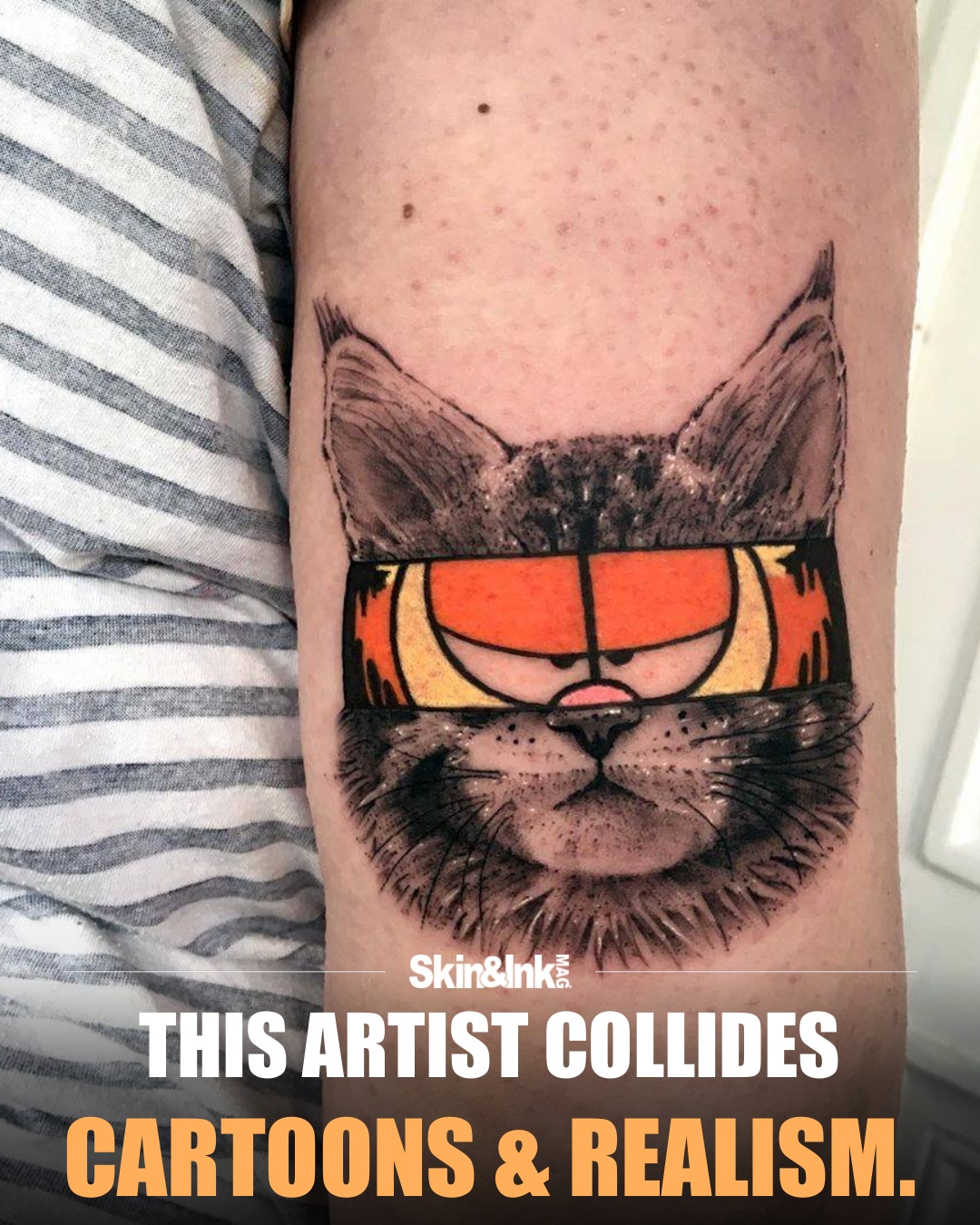
The seam is where a Mat Rule tattoo gets interesting. One visual language promises volume, texture, and believable light. Another arrives with flat color and the unmistakable shorthand of a cartoon. Put them together and the eye has to negotiate two sets of rules inside the same image. That moment of adjustment is a large part of the fun.

The French artist brings soft black and grey into direct contact with a strong, bright palette. His combinations allow the differences between tattoo approaches to stay visible. The basic contrast is easy to name. Making it feel like one picture is the harder job.

Realism asks us to believe in a surface. Shading can suggest the roundness of a face, the weight of an object, or the direction of a light source. Cartoon drawing compresses that information into a few quick signals. A contour and a block of color may do work that takes many tonal transitions elsewhere. When these systems share a tattoo, each makes the other more obvious.

That contrast gives the humor its structure. The viewer recognizes something familiar, then notices that part of it has been translated into a different language. The joke happens through looking. A long explanation would only slow it down. At the same time, the image has to survive beyond its first surprise, which makes the balance of shapes and values especially important.
Look at where the styles meet. Is the transition abrupt? Does one section appear to overlap another? Where does the strongest color pull your eye? Those questions offer more than a quick search for a favorite character. They reveal the decisions that make a hybrid image coherent, even when its parts seem to disagree.

The approach also changes the way we think about nostalgia. Familiar cartoon imagery can arrive carrying years of associations, but those associations belong to each viewer. Rule’s combinations open the door without dictating which childhood memory is supposed to walk through it. We can enjoy the collision without pretending every wearer has the same relationship to the source material.

For collectors, the work is a useful reminder that a concept can live in the treatment as much as the subject. Two artists could choose the same figure and build entirely different experiences around it. With Mat Rule, the switch between pictorial systems becomes the subject you keep returning to.

Find the recognizable part first. Then look directly at the break. That’s where the picture starts misbehaving.
Explore more work from Mat Rule.