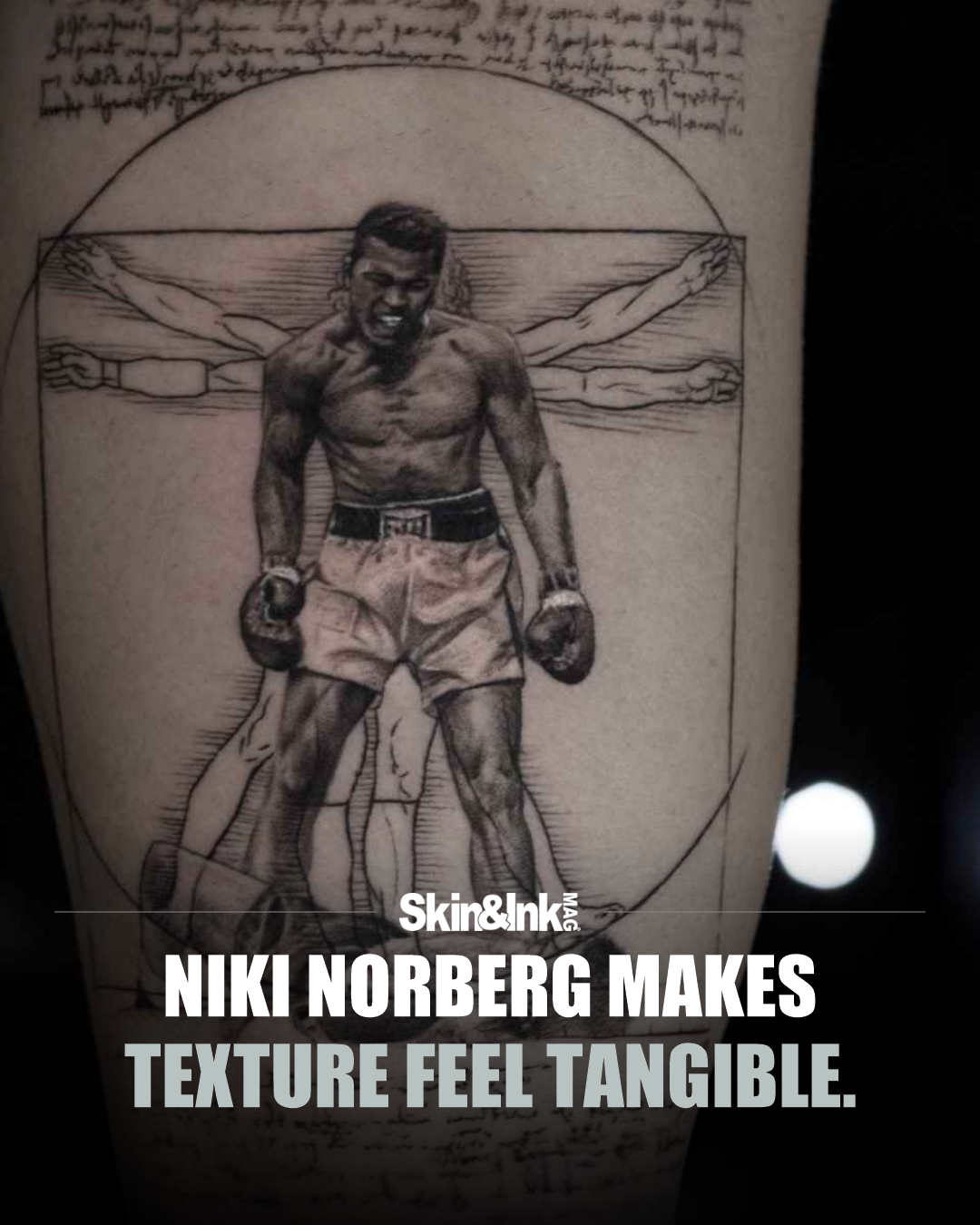
A boxer stands in front of a familiar arrangement of outstretched limbs, a circle and a square. One figure is shaded like a photograph. The other reads as a drawing. Niki Norberg brings the two together without making them look like the same kind of image.
That difference is the point of this tattoo's visual construction. The central boxer has weight. Dark gloves, shaded muscle and folds in the shorts give the body volume. Behind him, the extended arms and legs stay comparatively linear. The contrast lets the foreground figure separate from the reference surrounding him.
Norberg's public artist profile describes black-and-grey photorealism as his specialty. His work is often discussed in terms of detail, but the photograph shown here offers something more specific to look at: the meeting of two treatments of the human body.
The recognizable diagram establishes a broad framework. The boxer interrupts it. The circle and square remain visible enough to identify the reference, while the central portrait changes the image's focus. You aren't looking at a straightforward reproduction of one source. You are looking at a combination whose parts keep their different visual languages.
The darkest areas help that combination stay readable. The gloves frame the lower torso. The shadowed face sits forward of the lighter lines behind it. The shorts form a broader pale section between darker passages. Those contrasts let the main figure command attention even with so much information around him.
Small script-like marks sit above and below the composition. In the photograph they contribute to the impression of a study page, but I wouldn't pretend to translate them or assign a private meaning to the tattoo. The visible relationship between the figures is enough to make the work interesting.
What I like is that the realistic section doesn't erase the drawing behind it. Both remain present. One asks you to notice likeness and volume; the other asks you to notice proportion and structure. The tattoo holds those two ways of looking together on a single area of skin.
It is a useful example of why realism isn't only about how closely an artist can reproduce a face. Choosing what surrounds that face can change the whole reading of a piece.
Norberg's image starts with technical recognition, then gives it a compositional reason to exist. The shading catches you. The relationship between the two figures keeps you looking.