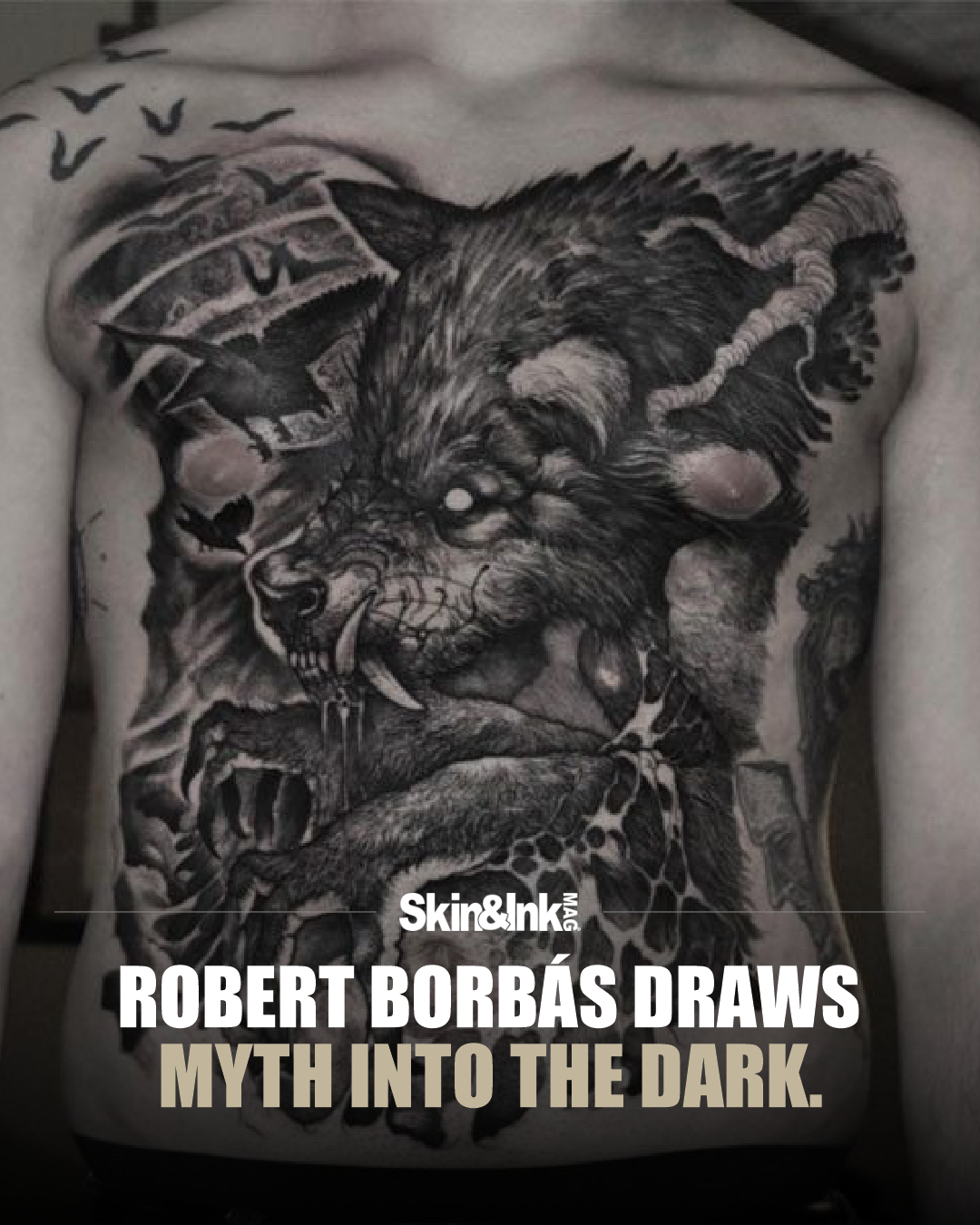
Robert Borbás makes dark imagery that asks you to inspect the drawing instead of simply reacting to the subject.
Working under the name Grindesign, the Hungarian tattooer and illustrator has a visual vocabulary filled with skulls, creatures and unsettling figures. In the work presented alongside his Highlark interview, a skeleton hangs from strings beneath a large hand. Nearby, a face seems to break into bone and curling forms. The subjects are macabre, but their effect depends on structure: where a line changes direction, where black gathers, and which details are allowed to remain open.

That relationship between illustration and tattooing is central to the story. A drawing can carry dense information across a flat surface. A tattoo has to deal with a curved, living surface and the practical demands of readability. The skill lies in deciding what survives that translation.
In a later Tattoo Life feature, Borbás discusses learning to distinguish the requirements of illustration from those of tattoo design. The publication also places his work alongside collaborations in music and his book, Incubus. That context helps explain why the same visual sensibility can appear across different formats without making those formats interchangeable.
The strongest angle here is the drawing underneath the darkness. Horror subjects come with an immediate emotional charge. A skull, a threatening hand or an impossible creature can get attention quickly. Keeping that attention requires more than adding another frightening object.
I would look for the routes the eye can take through the image. Is there a clear shape at the center? Do small textures support the larger form? Where does the drawing let you rest before sending you into another dense section?
Those questions make this work more interesting than a list of its symbols. They also keep us from treating dark imagery as one uniform category. The mood may be shared; the decisions that build it are personal.
Borbás's work gives the viewer both an immediate response and a slower reward. First comes the unsettling image. Then comes the realization that someone has organized all that visual pressure with a very deliberate hand.