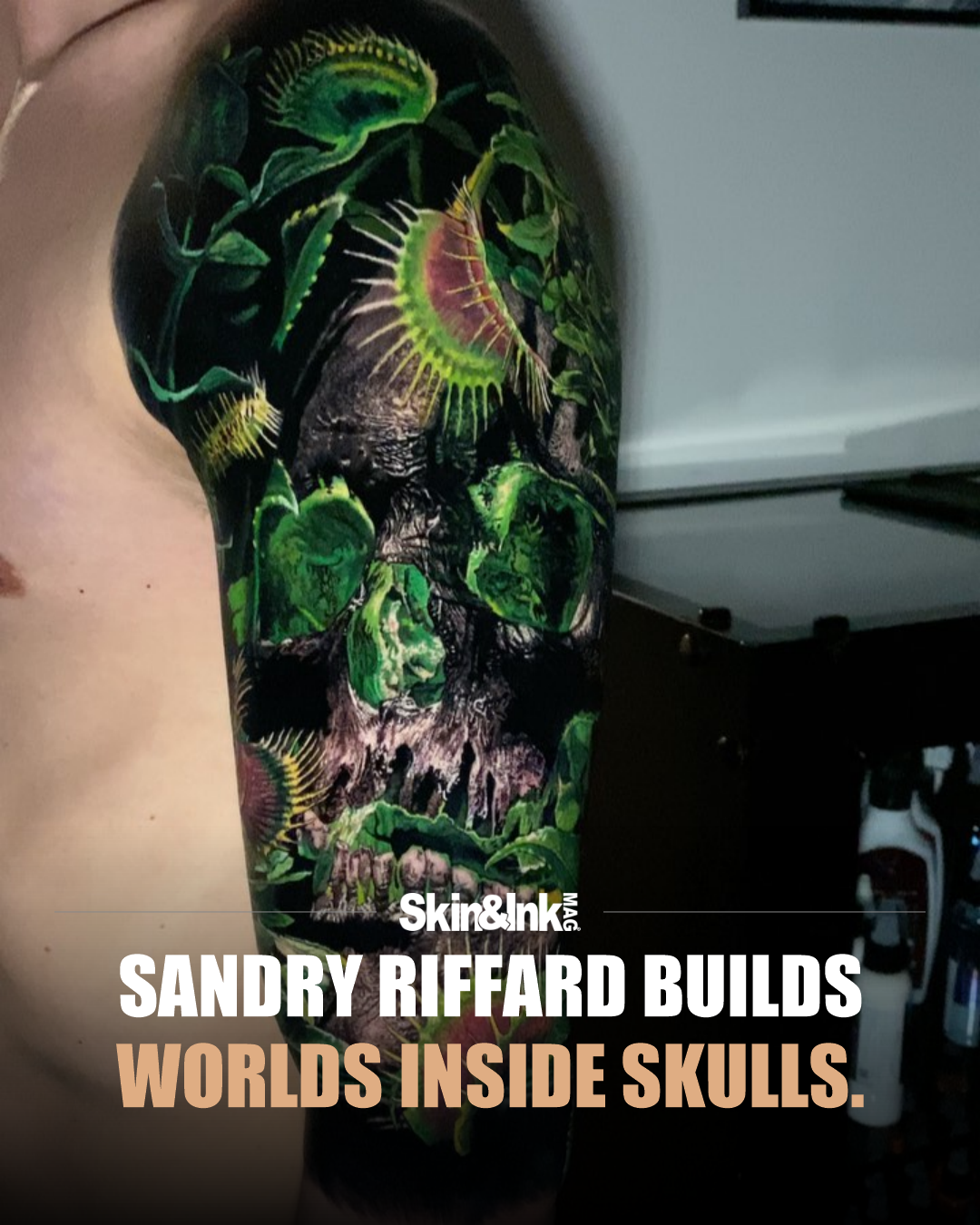
A skull is a familiar tattoo subject. Sandry Riffard gives you a reason to look at it again.
The French artist uses that recognizable structure as a container for something stranger. In the work reproduced by Inked, bone becomes a landscape for outer space, a video-game environment and stained-glass architecture. You can register the skull from across the room. Get closer and the image starts opening doors.

The stained-glass example makes the point especially well. Colored panels establish a larger ornamental structure, while the skull interrupts that structure with darker sockets and teeth. Your eye has to decide whether it is looking through the image or at its surface. The space-themed piece reverses the temperature: cold blue light appears to burn through the bone, with a planet above it. These are different pictures built around the same visual anchor.
That repetition is worth paying attention to. An artist can repeat a subject without repeating the same solution. The skull supplies an immediately readable silhouette. Everything happening inside and around it changes the mood. Riffard's work asks how far a familiar shape can be pushed before it stops being familiar.
In his DGN interview, Riffard credits a collaboration with photographer and digital artist Claudine Taillandier for developing these layered skull concepts. He describes her role in design and his focus on tattooing. Their use of color and themed compositions moves the imagery beyond its automatic association with death. That makes the skull a structure for a larger story.
For me, the interesting part is the hierarchy. Complex tattoos still need somewhere for the eye to land. A recognizable central form gives the smaller ideas room to exist without making the whole image unreadable. It also creates a second viewing distance. A quick glance and a close inspection become two different experiences.
That is the reason to spend time with this work. The initial impact gets your attention, but the smaller decisions keep it. Look at where the brightest color is placed, where the darkest areas hold the composition together, and how much information is packed around a shape you already know.