A backpiece has a problem before the tattooing even starts: it has to belong to a back.
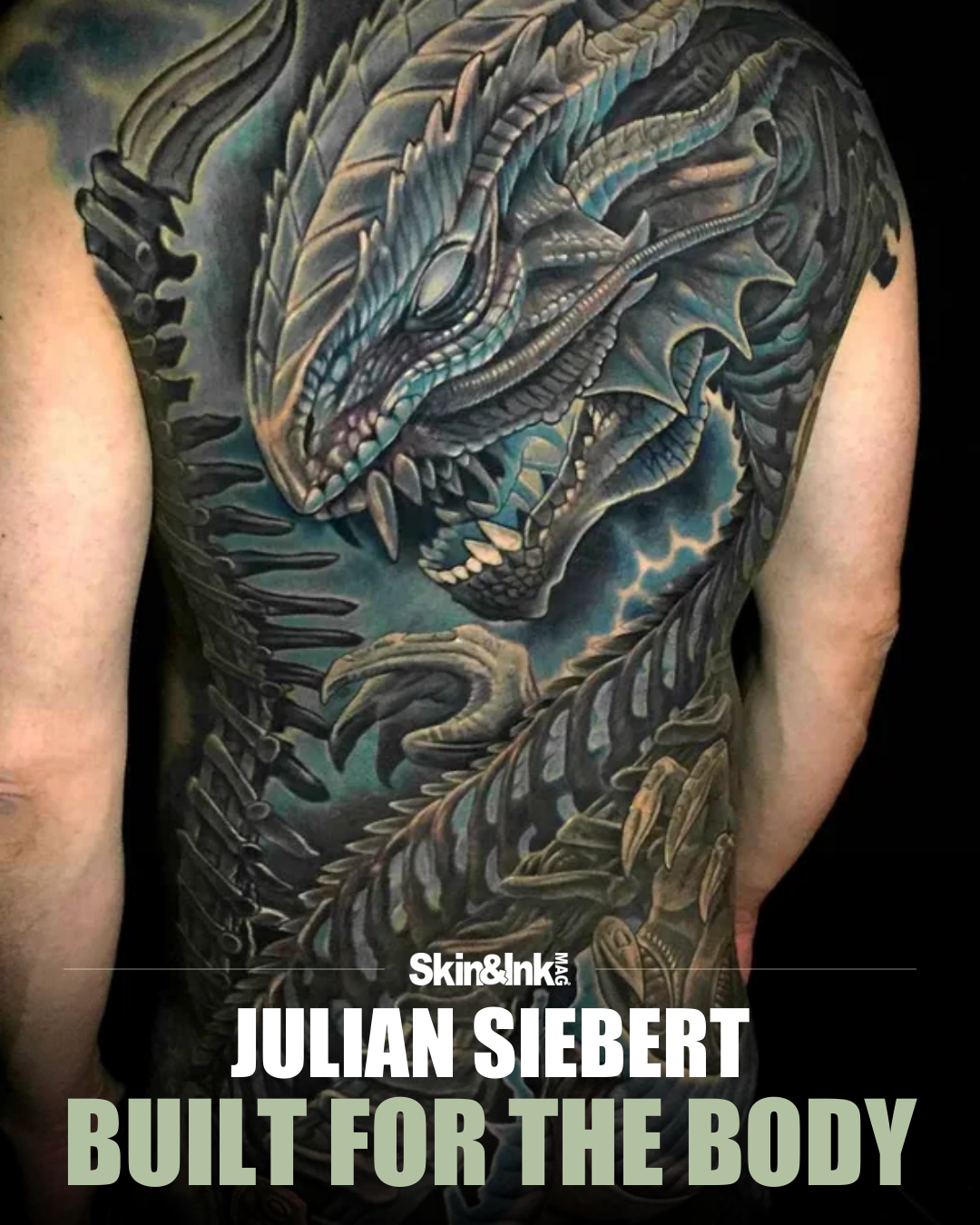
Julian Siebert’s work gives us a good reason to start there. In the piece featured here, a biomechanical creature stretches across the upper back and down the torso. Its head establishes the main point of attention, while layered ribs, ridges and armored shapes carry that attention downward. The surface looks crowded with information, but the larger movement stays readable.
The body isn’t hiding behind the drawing. It’s helping organize it.
In a 2020 Tattoo Life interview, Siebert described sketching directly on clients during a drawing appointment so he could work with body shape and proportion. He also discussed drawing with both hands at once, a method he connected to pinstriping and his difficulty drawing symmetrically. The interesting idea is finding a way to make a design fit a living surface.
In this piece, the parts relate deliberately to one another. The creature’s head gives the composition a recognizable anchor. The elongated structures below it provide a route through the rest of the tattoo. Repeating edges build rhythm without turning every area into the same texture.
The palette also does more than color in a monster. Cool tones and warmer highlights separate overlapping forms, suggesting hard surfaces and deep recesses. Dark gaps keep adjacent shapes from collapsing into a single mass. You get the impression of an anatomy that could continue underneath the skin, even though the anatomy itself is imaginary.
That’s where biomechanical work gets compelling. It can suggest a body inside the body, something built from parts that look almost functional. The viewer doesn’t need a diagram explaining what every piece does. The relationships between those pieces make the fiction feel organized.
Siebert has described choosing a style around a client’s idea rather than committing himself to one style. This backpiece stands on its own within that broader approach. It’s expansive, intricate and unmistakably concerned with the shape carrying it.
The creature is invented. The back is real. The tattoo works in the space between them.
Explore more work from Julian Siebert.
Tattoo artwork by Julian Siebert.
Sources: inkppl.com, www.tattoolife.com.